Whenever I’m browsing a thrift shop or antique store I like to keep an eye out for musical instruments, specifically guitars. As a musician myself, I can attest to the sentiment that some guitars – new or old – have a feel to them. A pre-existing entity, spirit, or vibe (for lack of a better word) that can live within the instrument, giving it character.
In my experience however, this feeling is seldom found. Missing hardware like tuning keys, knobs, pickups, or strings are common/minor defects one can spot quickly and replace/fix easily. More serious, “red flag” issues to look out for would be things like warped, cracked, or misshapen wood, which can change the sound and playability of the instrument. These indicators are signs of temperamental humidity, some rough years on the road, or simple neglect, and they leave long-lasting scars on the instrument. Every dent, ding, bend and bump in the wood has an effect on not just the look, but the sound of the guitar as well.
Still, whenever I discover a guitar at a thrift store I cannot help but pick it up and strum a few chords. My little way of “checking for vitals”, you could say. Most of the time unfortunately though, the guitars I find at antique shops or yard-sales are past the point of repairing. And more often than not, the price is usually way more than what I’d be willing to pay. But sometimes you get lucky. And (spoiler alert!) I got lucky.
May I present, Chapter 8 of the blog:
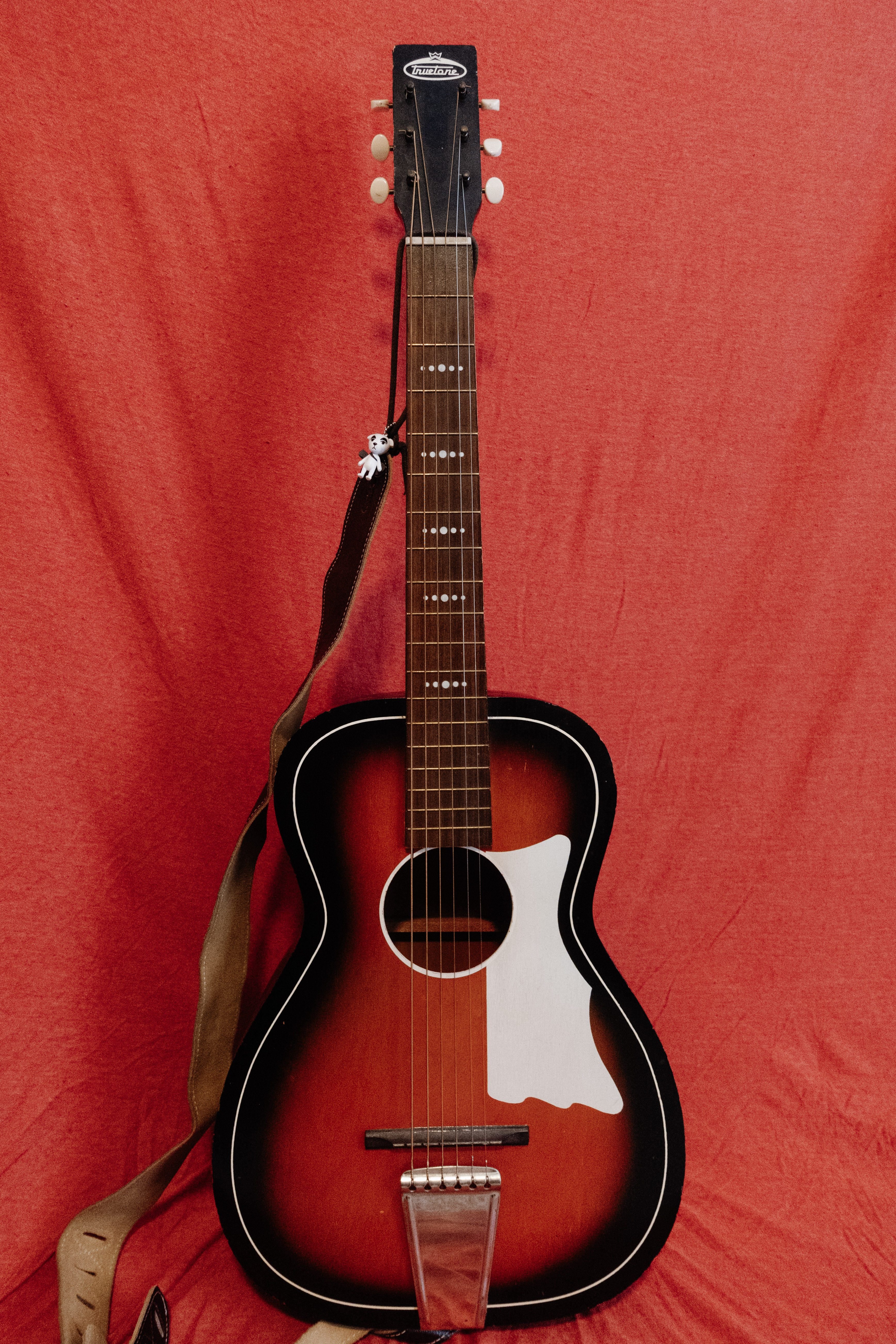
The Truetone Parlor Acoustic Guitar
Getting To Know The Guitar (Again)
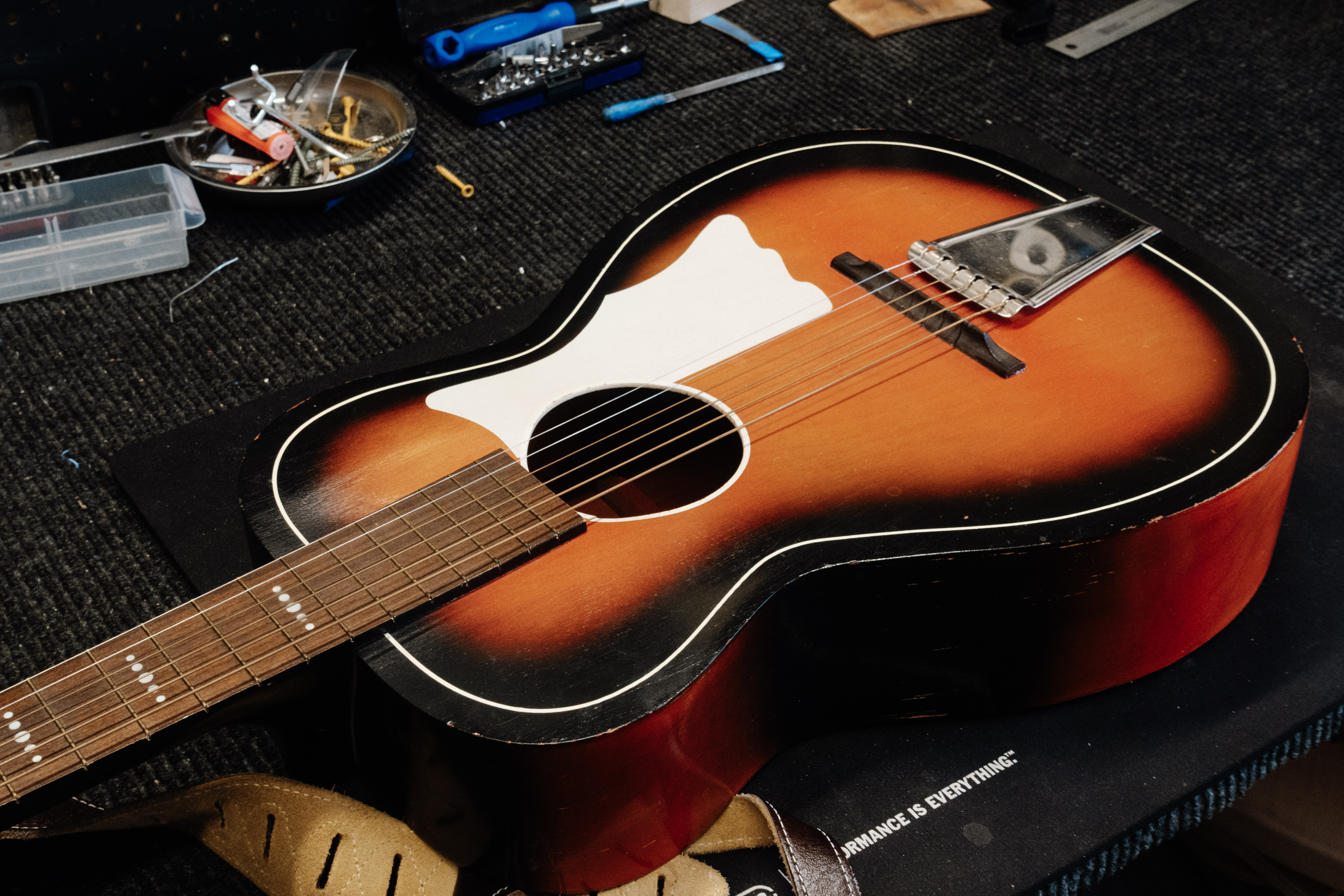
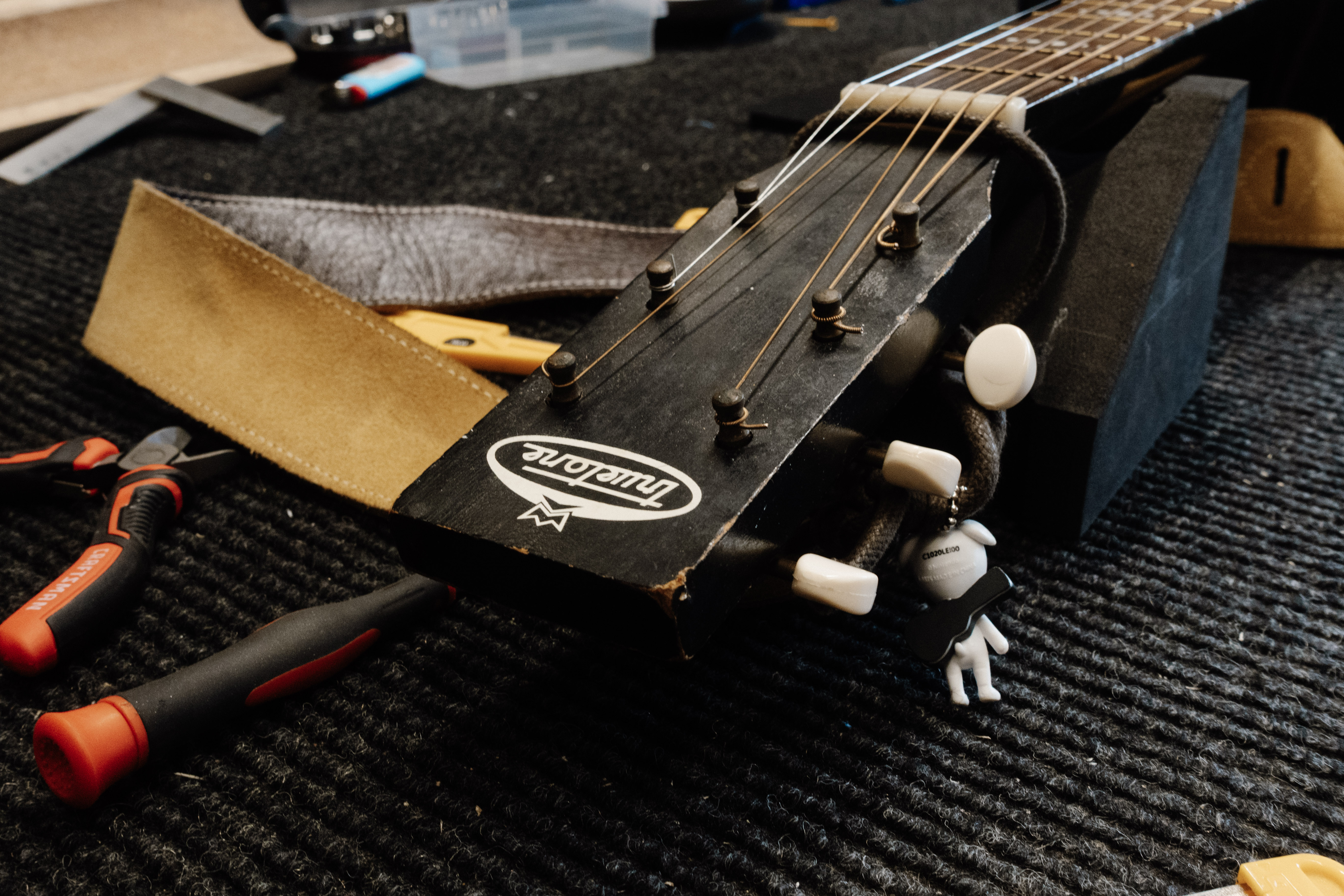
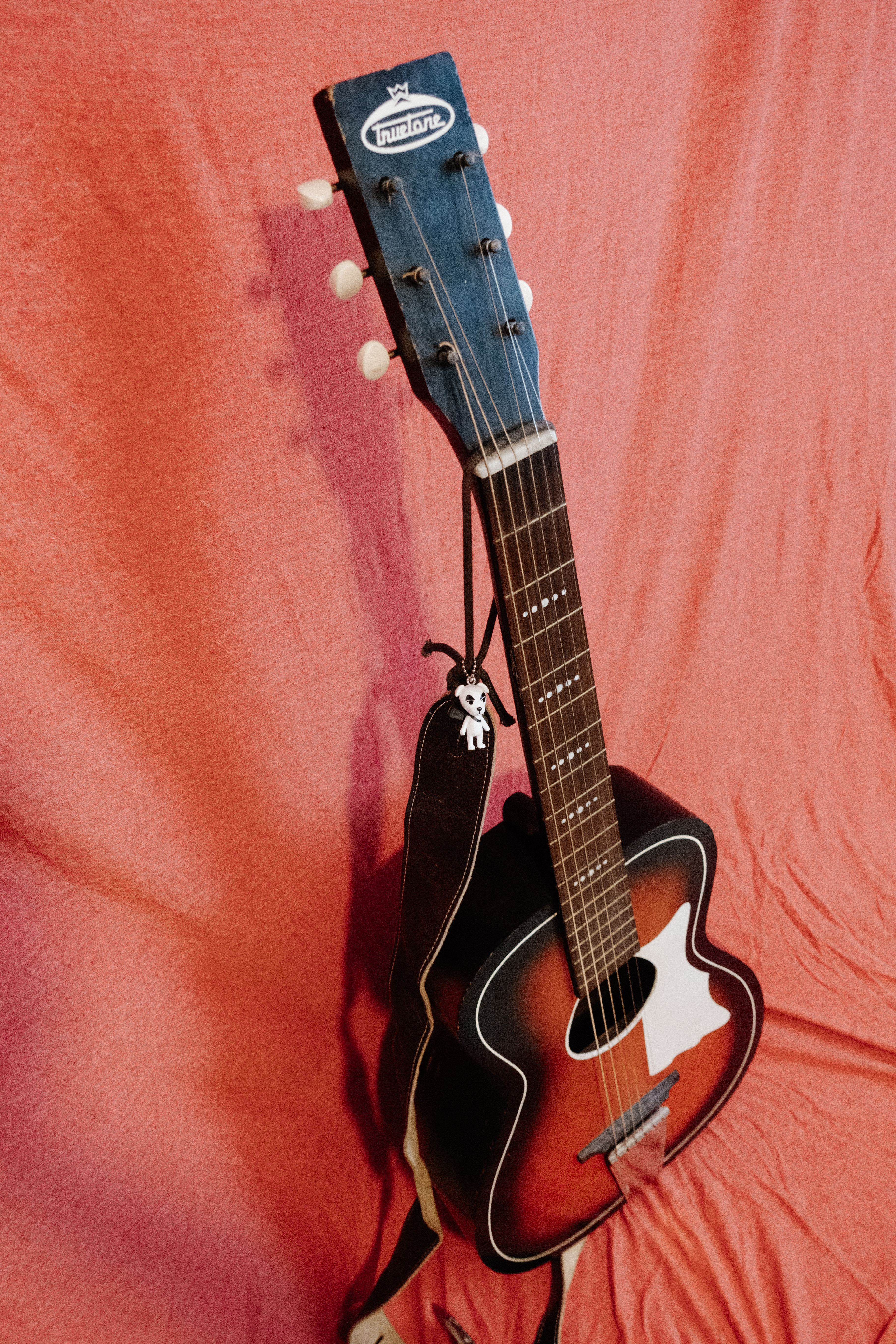
Looking back through my archives, I purchased this guitar in 2018 for $65 from an antique store in Arundel, Maine. Below are the first photos I took of it once I brought it home to my apartment.
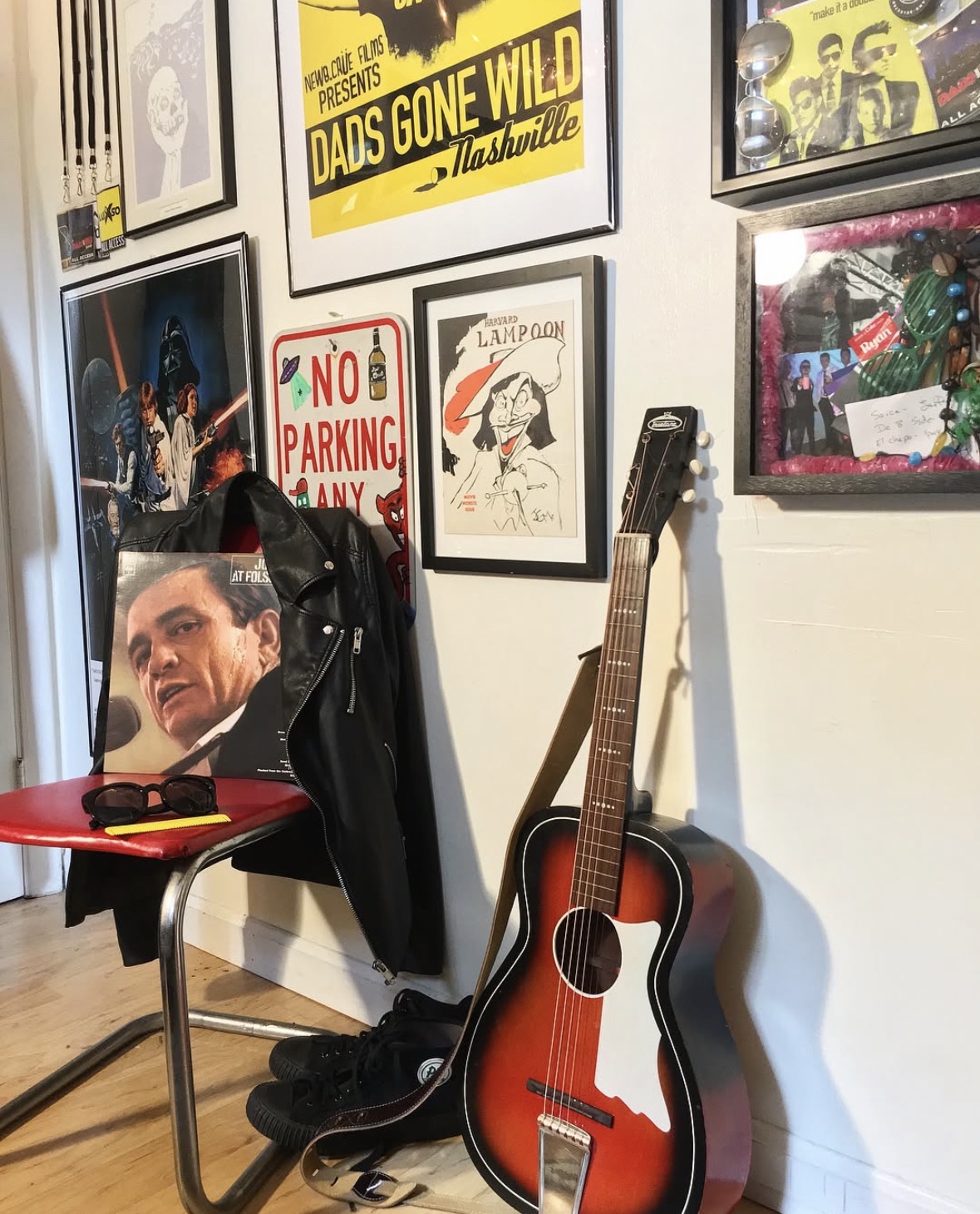
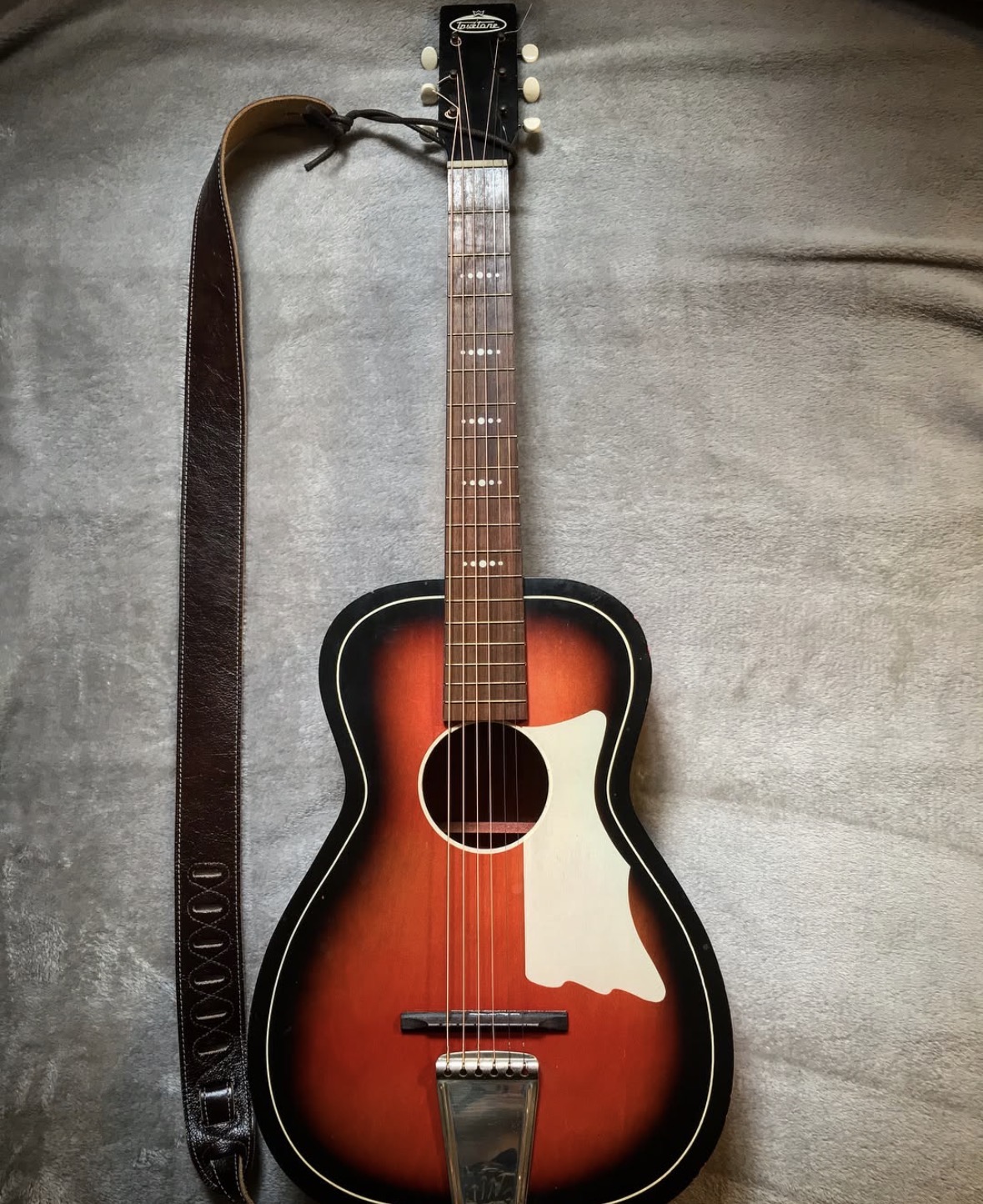
At the time, I didn’t know much about this instrument aside from:
- 1. It was old (the painted-on pickguard and “floating” bridge were my first signs)
- 2. It was smaller than your standard acoustic guitar
- 3. It had a unique look and sound
Since then, this guitar has more-or-less been my longtime roommate. It has moved with me from apartment to apartment, being played occasionally whenever a song idea would strike, or a friend would come over and the inevitable jam would ensue. For awhile (like a lot of things I find thrifting) I saw it more as a decorative piece than something I’d actively use.
Now that I think of it, there was one instance in late 2018 where it joined me on a trip to Nashville, Tennessee, where I recorded a demo with it – but more on that later!

Ever since then, the guitar has been hibernating within its case, stacked between my other instruments in my home-studio. That is, until I decided to pull it from retirement once more and give it the attention it had always deserved.
First Step: A Check-Up at The Guitar Shop
To start, I brought the guitar over to my good friend Matt at Sohl Guitars in Harrison, Maine for a much needed check-up. Matt – a skilled luthier who has worked on many of my other instruments over the years – was kind enough to give this old axe some love, and bring it back to a cleaner, playable state.
While the neck has some incurable warping going on (most notably up past the 12th fret where the the neck attaches to the body) Matt was able to clean up the fingerboard, tighten the tuning pegs, and reinforce the floating bridge. He also threw on a fresh pair of strings! What a guy.
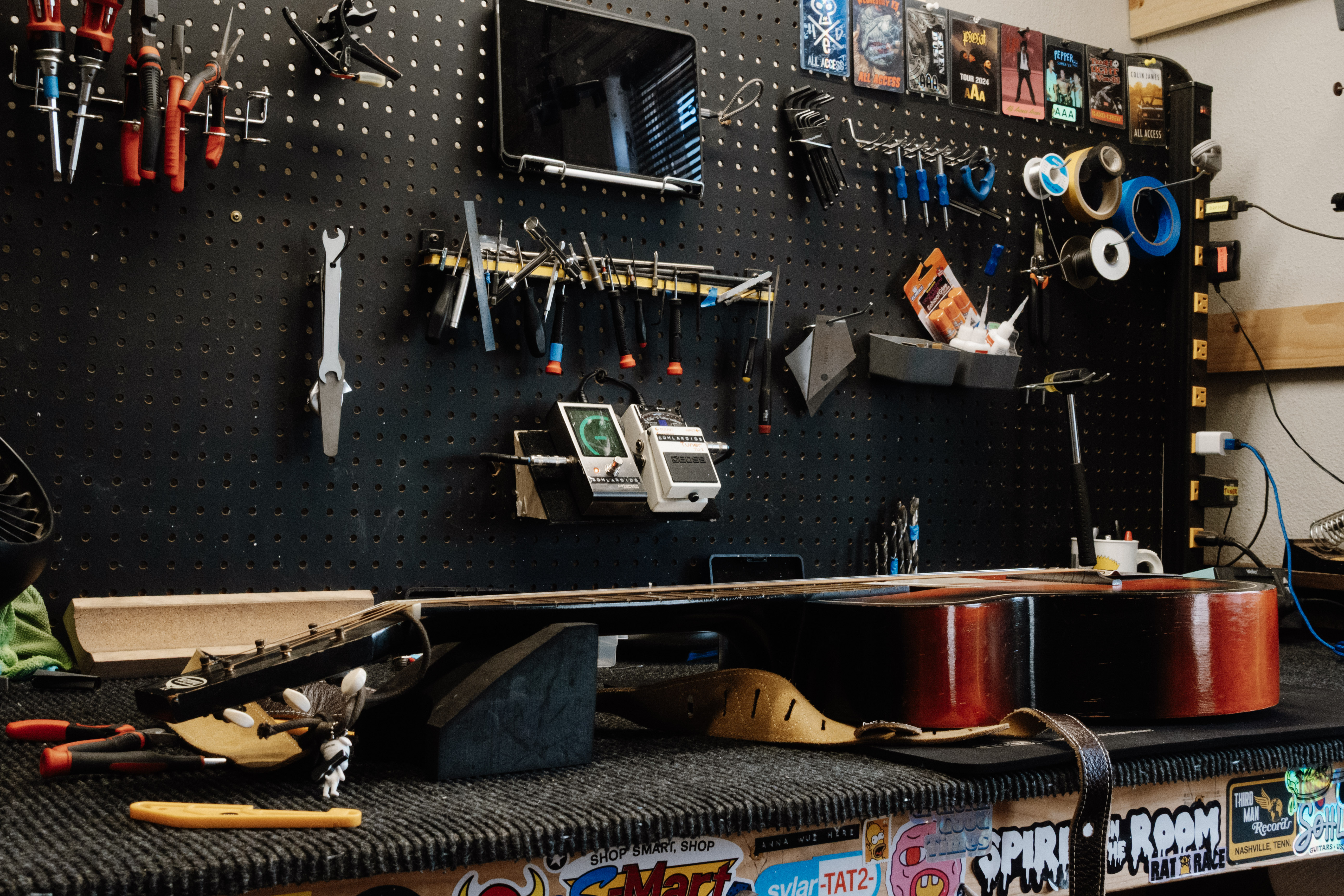
Now that the guitar was in better shape, I was determined to do something with it. Up until this point, I had done little research on the instrument itself – and so my next step was to hit the books.
The Investigation Begins
Like all things, guitars usually come with model names and serial numbers to help classify their place within the instrument-world. In my experience, these things are printed, etched, or painted on the head-stock, which is often centered between or beneath the tuning pegs.
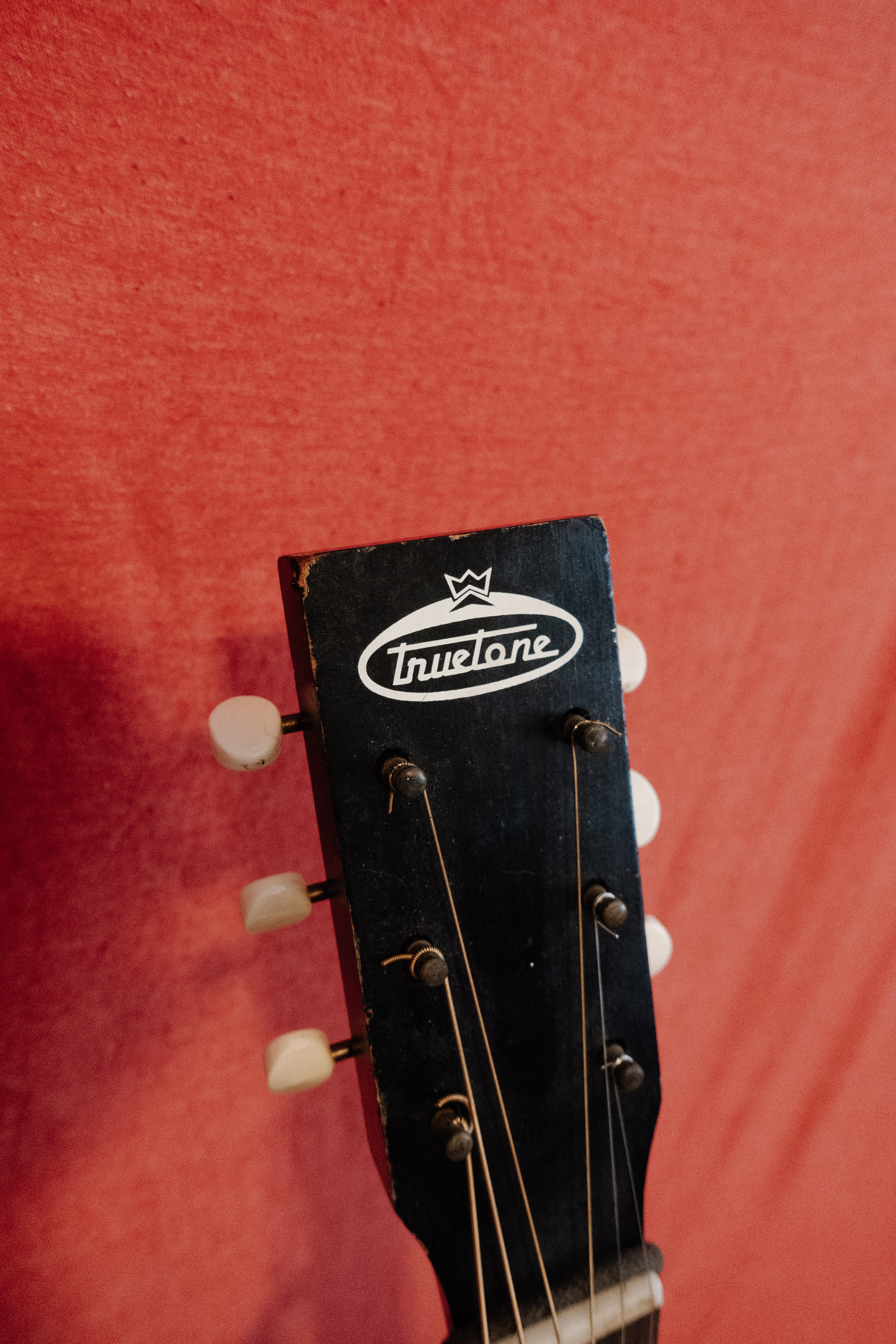
In this case, “Truetone” (seen above) is the model or brand of this specific guitar. But what was the serial number? Acoustic guitars will sometimes put this information inside the sound-hole of the instrument, down beneath the strings in the hollow body of the guitar. Unfortunately, likely due to the age of the instrument, the stamped-on serial number within the body of the guitar has become mostly illegible.
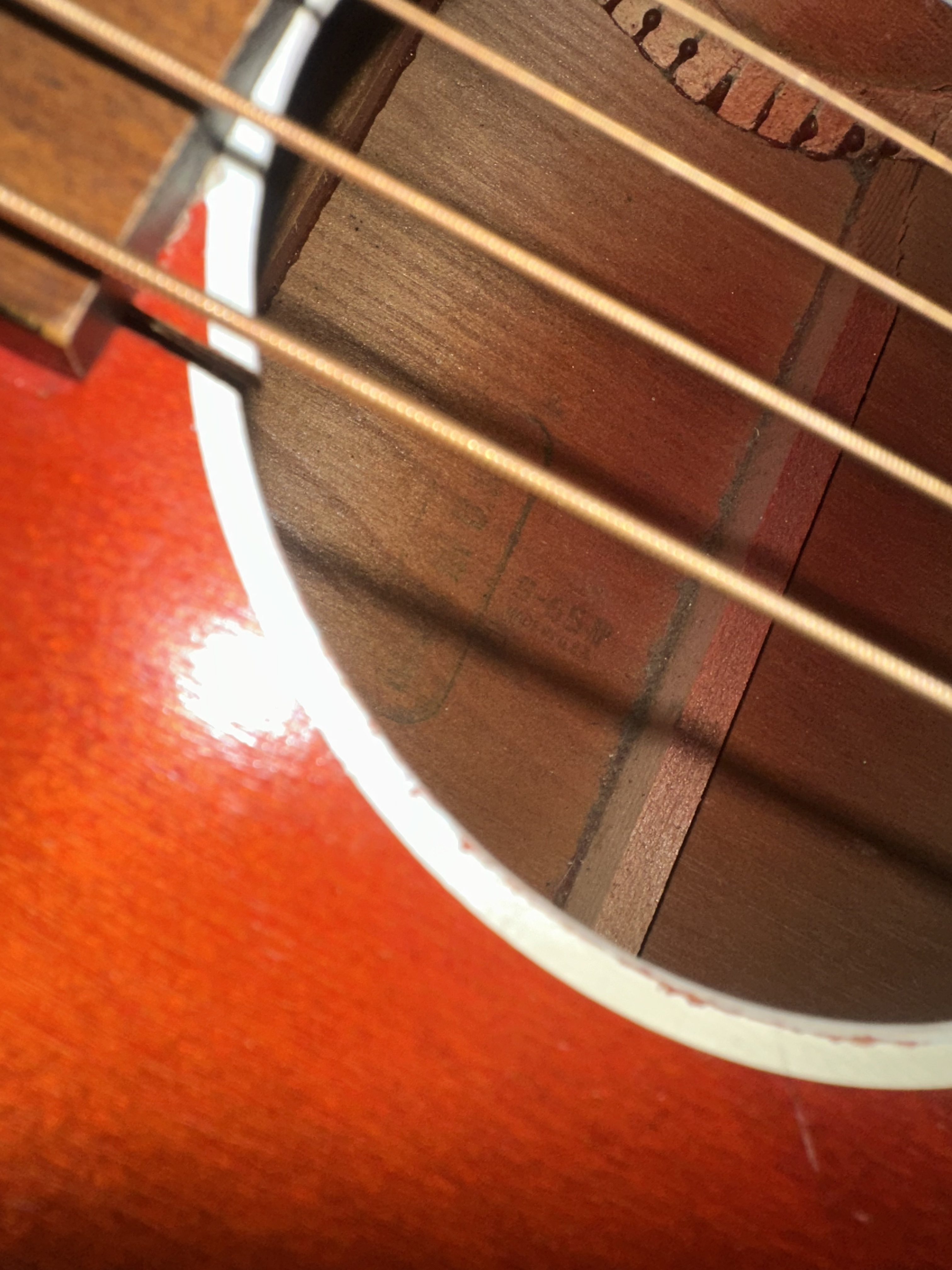
Aside from a faint outline of what was once a legible serial number, the only remaining information that I could make out/get a good photograph of were the markings: “S-65” and the phrase “Made in USA”. While not ideal, these details were still something to go off of. Armed with the “Truetone” brand-name and the partial information from inside the guitar (pictured above), I took to the internet to uncover more.
Parlor Guitars 101
Earlier, when the guitar was on the luthier-table at Matt’s shop, I was able to measure and confirm that this specific model Truetone has a 24-inch scale-length, with a nut-width of 1 and 3/4-inches. These measurements, along with the barely-visible “S-65” marking within the instrument, turned out to be extremely helpful in my research.
It’s important to note that before the invention and popularity of the dreadnought-style guitar in 1916 (we’ll get into that in a second), the parlor guitar was not viewed as small to the general public.
The lore behind the name “parlor” is interesting as well. Some sources claim these instruments were named after the rooms in which they were played in. Parlors – also known as “parlor rooms” (seen below) – were a common communal-space in middle/upper-class homes during the late-19th century where entertaining took place, often incorporating music. Others say the guitar’s name comes from the musical-tradition the instrument was a part of (parlor music).
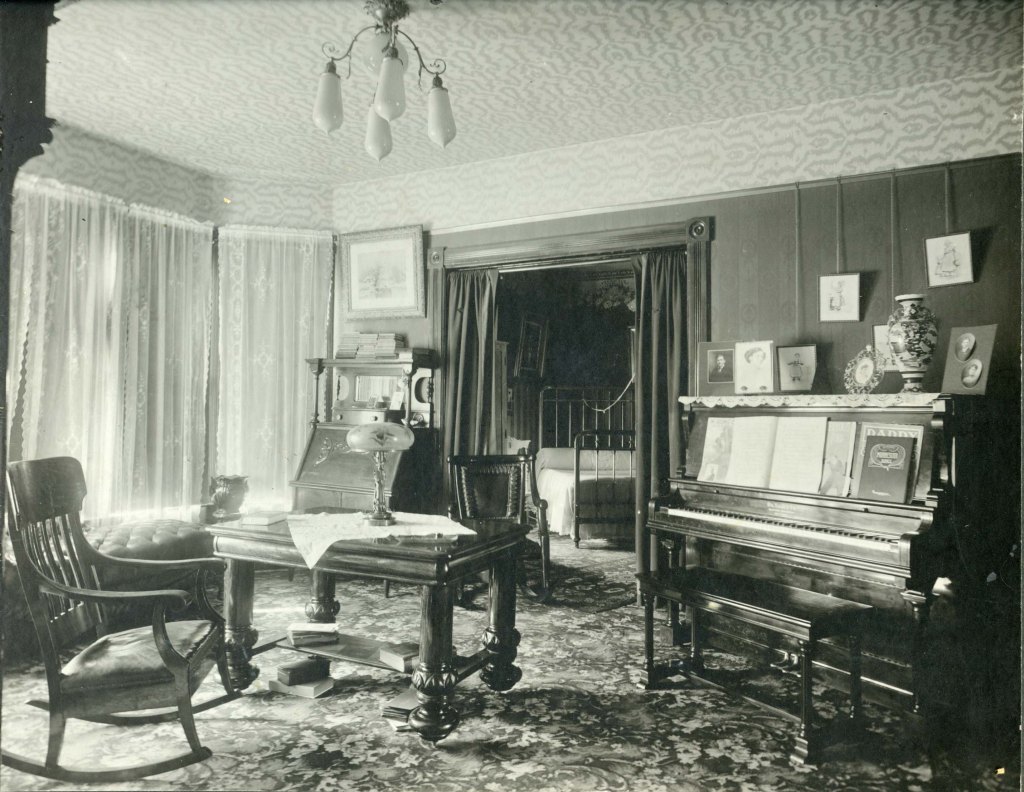
From what I understand, parlor music was a form of popular music, comprised of instrumentals and sing-a-longs that stemmed from sheet music of other genres, and it was mostly played on pianos or “piano organs” (Danner, “The Guitar in Nineteenth-Century America: A Lost Social Tradition”) – but sometimes on guitar.
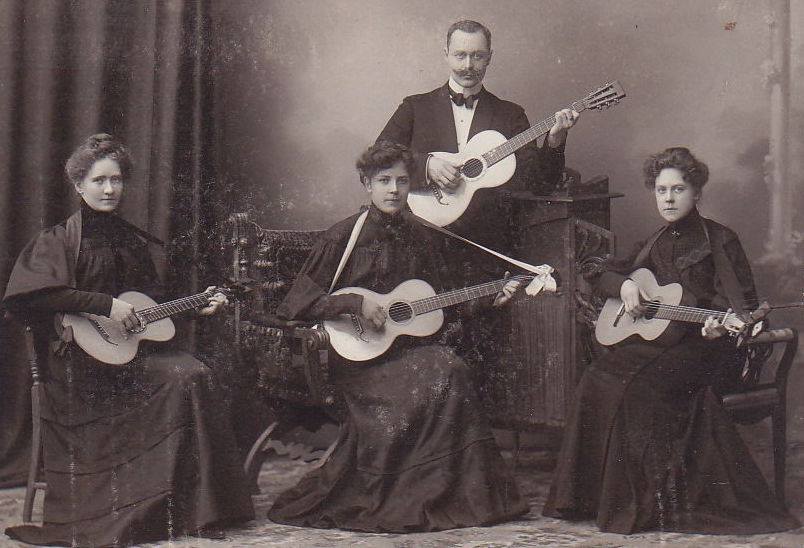
The shorter scale-length and compact body of the parlor guitar suits nearly every age and skill-level, allowing the instrument to be played practically anywhere, by anyone. Artist and contributor to Smithsonian Music, Mike Seeger echos this in his informative 2016 article “A Brief History of the Guitar and Its Travel South“ for the Smithsonian. In it, he highlights key moments of the journey and popularity of guitars such as the parlor as they made their way from Europe to, and throughout, America during the late-19th century and onward.
“Over the coming decades the guitar would prove itself the most versatile, expressive, portable, affordable, and accessible musical instrument for both amateurs and the most adventurous professional musicians.”
Mike Seeger, “A Brief History of the Guitar and Its Travel South“, 2016
If you’ve got the time, check out Mike Seeger’s 2007 album Early Southern Guitar Sounds. Featured in the above 2016 article for Smithsonian Music. Seeger’s 28-track album for Smithsonian Folkways Recordings focuses on the songs and sounds of the American south from 1850 to 1930 and using a staggering twenty-five (25!) guitars, Seeger takes listeners on an auditory and historical journey of the instrument and the music that were played on it throughout the decades. For fans of: “banjo-like styles, rags, blues, parlor and parlor-based styles, slide guitar styles, and many song accompaniment styles.”
Anyways – the size of the parlor guitar was common for the time, because bigger guitars…well, didn’t exist yet.
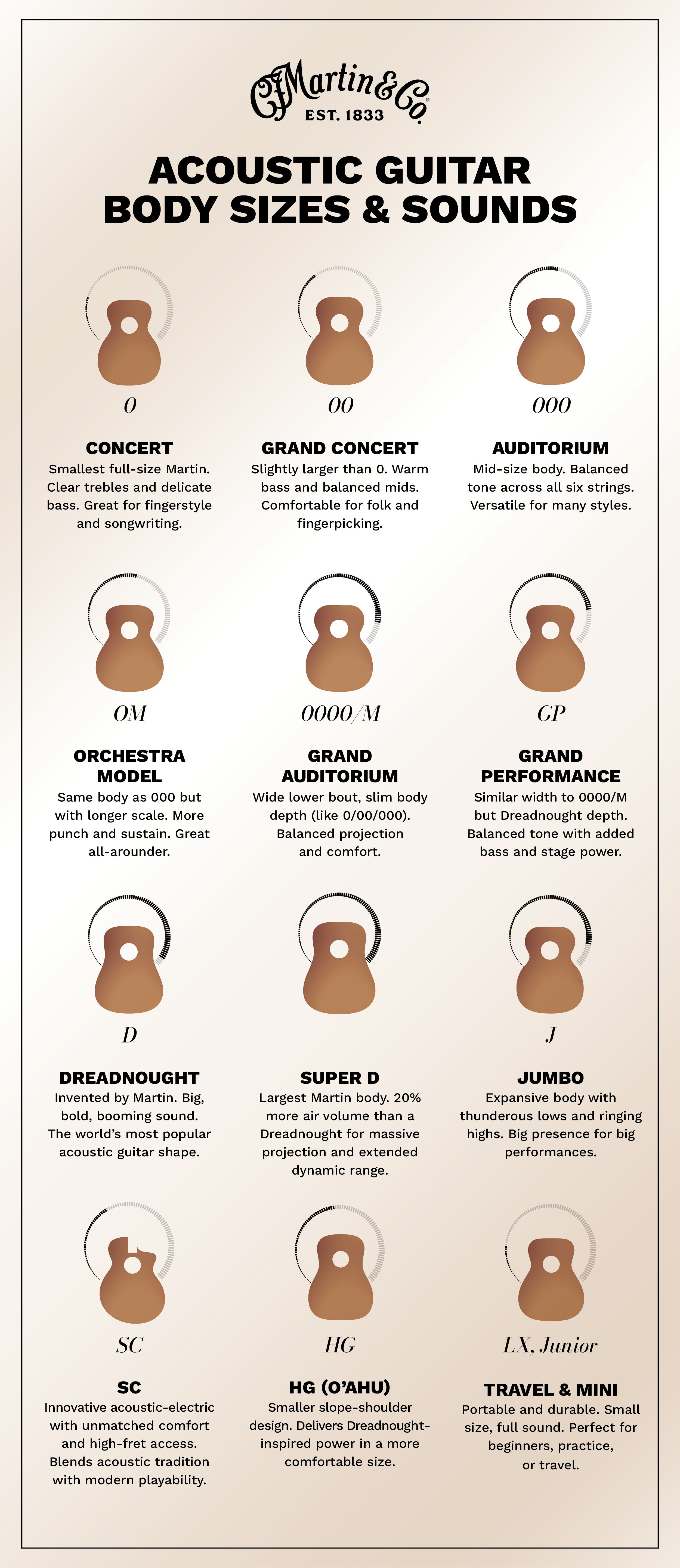
Originally developed by the now famous C.F. Martin & Co. (aka the Martin guitar company), dreadnought acoustics have generally larger bodies, which actually produce a richer, heartier, and overall louder sound.
Stood next to a parlor for example, the dreadnought-style guitar (which was named after a “huge” battleship funnily enough) will simply tower above it. In fact, even the smallest Martin acoustic guitar (known as the concert size, or “0”) is still bigger than most parlors.
If you need a good crash-course in parlor guitars and want to better understand how they differ historically from other string-instruments, check out “The Myth of ‘Parlor Guitars'” post by Paul Race. I learned a lot from his website in researching for this post. Also check out this informative chart (left) of acoustic guitar sizes from the Martin guitar company.
Meeting The Experts
Further web-sleuthing led me to a website dedicated to mid-century, parlor-sized acoustic guitars (aka, jackpot.) It was here – Vintage Parlor Guitars – that I was fortunate enough to connect with Stephen, who runs the website and also specializes in the repair, restoration, and sales of these instruments. He was kind enough to look at a few of the photographs I had taken of the Truetone guitar, and confirmed much of what I had already suspected to be true of it.
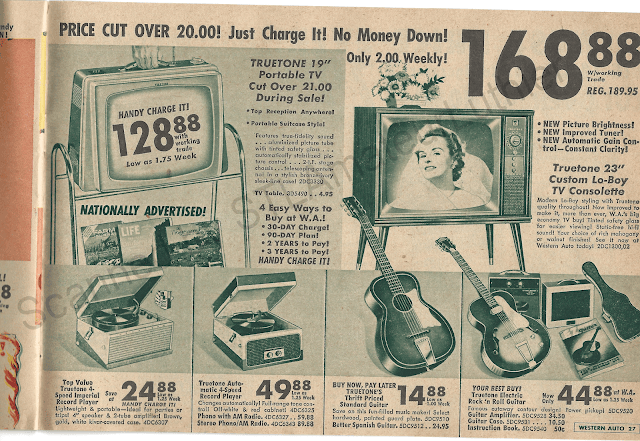
Stephen first assured me that this instrument was in fact a mid-century parlor guitar. It was sold under the brand name “Truetone” as the headstock implies, and was made by the Harmony guitar company at their Chicago, Illinois factory. The instrument was most likely made in 1965, and was probably sold by either the Western Auto Supply Company or Sears out of their shopping catalog(s) – a once popular form of shopping in the mid-late 20th century.
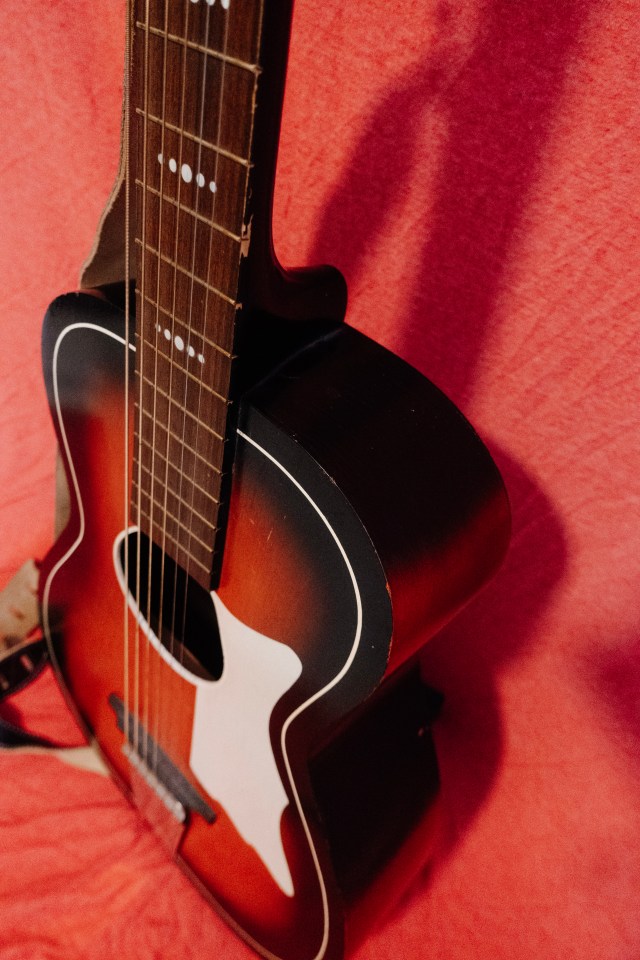
The Truetone, Stephen informed me, was likely made out of birch wood. The neck and fret-board are made out of poplar and were dyed to look “more exotic”. The instrument was also fashioned with brass frets, a sliding, “floating” bridge (one that is not fixed to the body of the guitar), and a nickle (or chrome) plated tailpiece. Stephen went on to say that this guitar was likely designed to accommodate nylon strings, rather than the steel ones I have on presently.
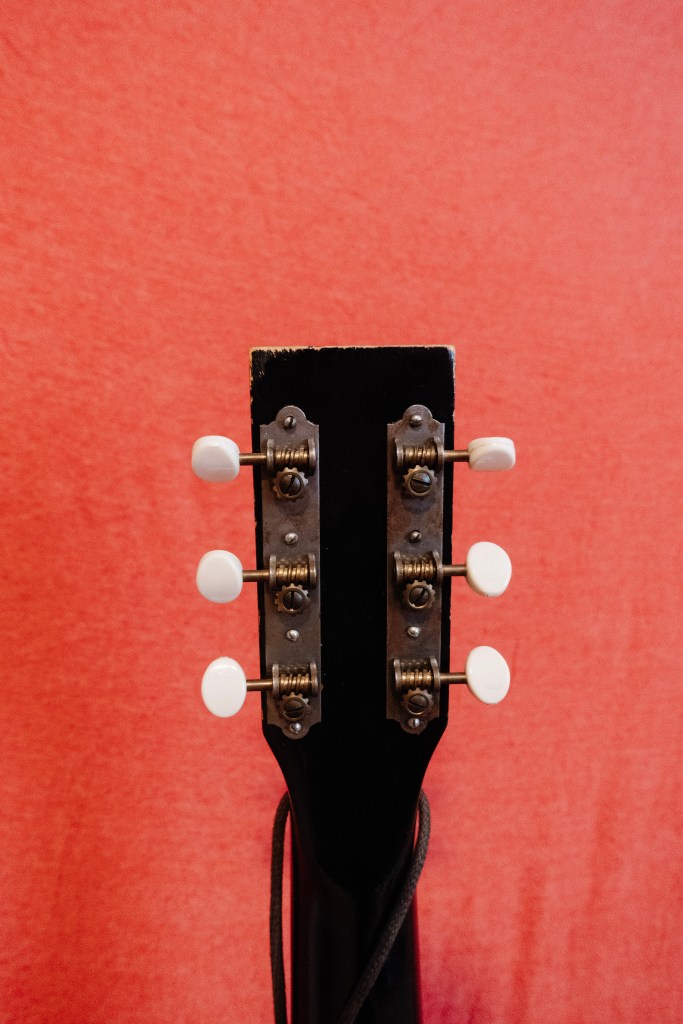
Learning all of this information from an expert like Stephen was a breakthrough moment.
Surely, I thought, there wasn’t much more I could learn about this guitar. It felt as though I had scoured every nook and cranny of the internet searching for information on this guitar. That was until I received a reply-email from the Harmony guitar company.
Mike, a specialist there, was kind enough to take a look at the photos of my instrument and answer some of my remaining questions, as well as confirm or deny some theories I had regarding the guitar’s origin.
Firstly, Mike from Harmony guitars confirmed that my Truetone acoustic was more than likely based off the “Stella” base-model that the company produced over half a decade ago, specifically the “H1141” model in red burst color. Back in the day, guitar companies like Harmony would make instruments for stores and other manufacturers, often rebranding the guitars with different names, such as: Stella, Astro, and Truetone.
Truetone specifically was a line of instruments, amplifiers, record-players, and television-sets sold by the Western Auto Supply Company, a retail chain in the United States from 1909-2003. Beginning in Kansas City, Missouri, the business sold a plethora of items out of catalogs and storefronts across the country during its time in operation. Of these items, musical instruments were often featured alongside other electronics and home goods. A majority of these instruments (like my parlor guitar) were produced by either Kay or Harmony, just as Stephen and Mike had told me.
Despite being competing brands, both Kay and Harmony seemed to dominate the musical-instrument manufacturing market during this time. If you were a retail chain in the early-to-mid 20th century (Sears, Western Auto, St. Louis Supply Co., JCPenny’s, etc.) and you sold musical instruments, odds are they were made by either Kay or Harmony. Competing instrument manufacturer Kay – which was founded in Chicago by Henry ‘Kay’ Luhremeyer in 1931 – was producing up to 100,000 instruments annually by 1935.
By the late-1930s, over half of Kay’s musical instruments were sold outside of Chicago (IL) through various distributors, therefore making them a force to be reckoned with for competitors. Like Harmony, their large variety included other stringed instruments such as: mandolins, lap steels, banjos, and other models of acoustic and electric guitars.
“Up until the mid-70s, we produced more instruments than any other company in existence, crafting anything from archtops to flat-tops, ukuleles, banjos and violins.” – Harmony Guitar Company
Kay vs Harmony: Battle of the Brands
Admittedly, this is where things start to get a little confusing for me. Both Kay and Harmony were giants in the guitar manufacturing world during the early-to-mid 20th century in America. Each company used similar tactics of modifying the base-models of their instruments to sell for different markets, and therefore expanded their reach to musicians throughout the country. For example, two customers may order the same model guitar, but where they live determines what brand that guitar would be, and ultimately what logo would be on the headstock. Speaking of, the red burst “Truetone” parlor guitar I have is nearly identical to other guitars released under the Astro, DH, and Stella brands (see below) from this era.
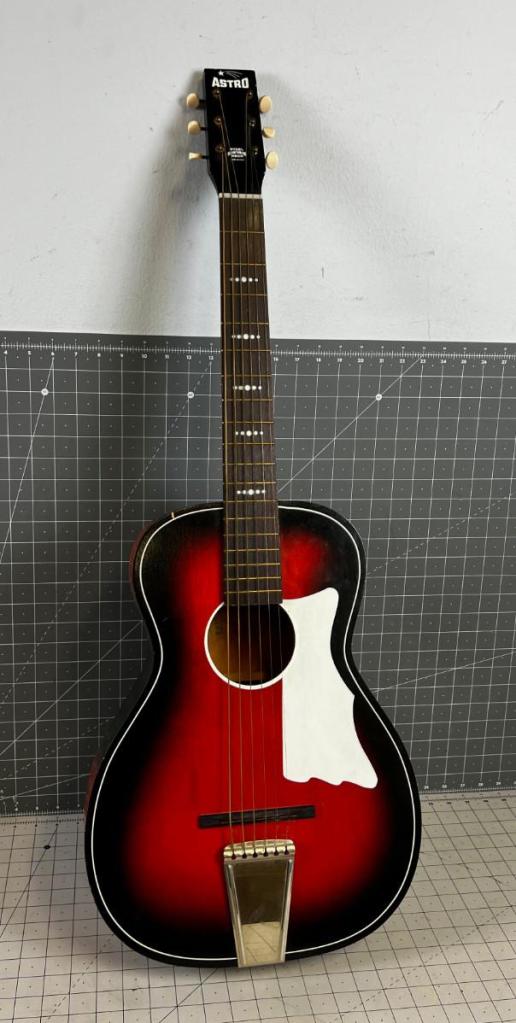
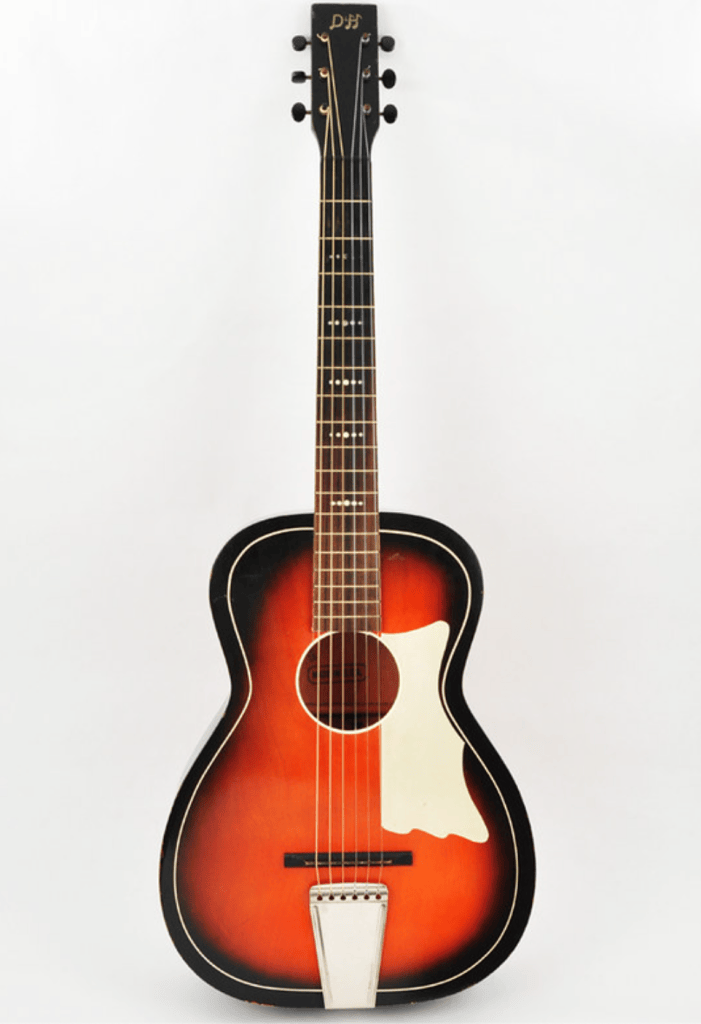
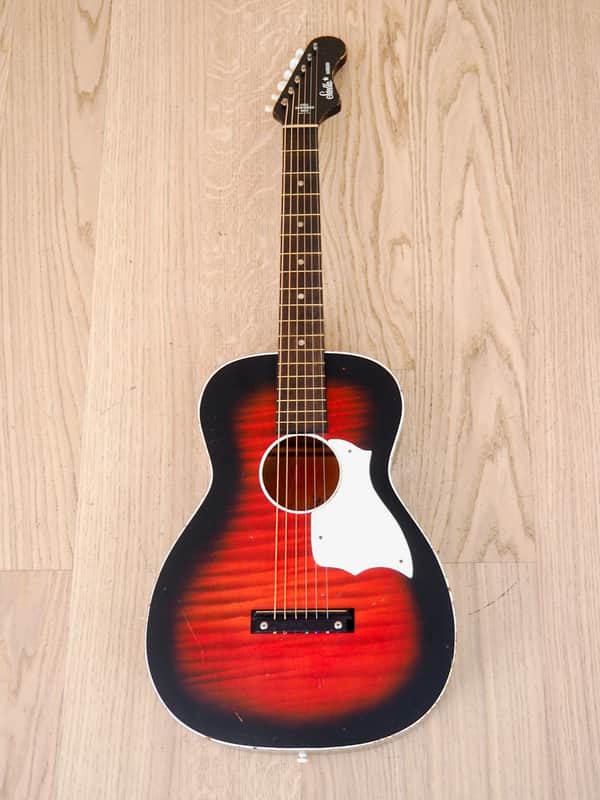
Essentially, both Kay and Harmony (both Chicago-based) made “Truetone” branded guitars. It was one of many rotating base-models that was modified on a store-by-store, manufacturer-to-manufacturer basis. Some stores, catalogs, and retail-outlets got Harmony-made “Truetone” guitars like mine, others got them from Kay. What determined who got what seems to be a matter of timing (aka what year it was.) Even the models with “Astro” and “DH” branding only differ from their “Truetone” and “Stella” counterparts in small ways, which makes telling them apart a bit tricky. Different shaped headstocks are an obvious tell, but one can also look at the specs of their instrument (material it’s made with, the shape of the guitar’s body and color of the wood, etc.) to more accurately pinpoint its origin.
In fact, just this Spring Harmony released a new parlor acoustic guitar called the “Stella”. Its features are (as you would expect) very similar to my Truetone. The 2026 Stella has 20 frets, a spruce top, and a mahogany body with a sunburst finish. The neck – also made of mahogany – has a rosewood fretboard and dot inlays. It’s a beautiful refresh of the classic model, and was so cool to find available again for sale (and from Harmony no less!)
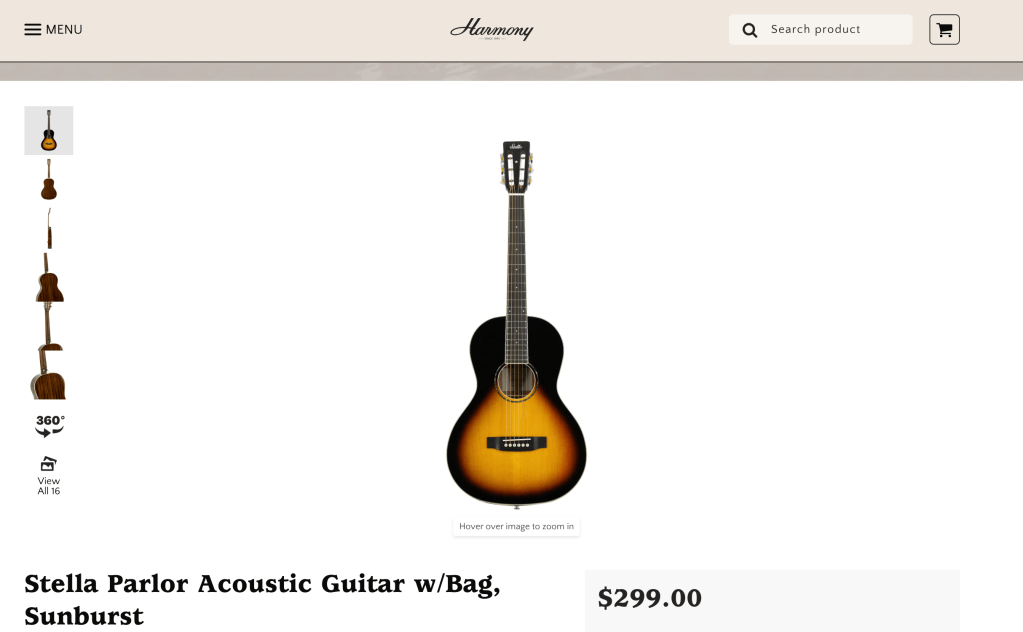
“First built in 1899 by Oscar Schmidt, the Stella name found its way into the Harmony family in 1939, and into the hands of Woody Guthrie, Elvis Presley, and Kurt Cobain along the way. The Foundation Series Stella picks up that thread. It’s a parlor-sized acoustic built for songwriting, late-night practice, and the kind of melodies that don’t need much room to breathe.”
The Stella Parlor Acoustic Guitar | Harmony Guitars
Putting The Pieces Together
Mike and Stephen were able to confidently say that my guitar was Harmony-made, therefore solidifying the instrument’s birthplace to be Chicago, Illinois. Additionally, both guitar experts confirmed that my instrument was most likely sold by a retail outlet like Sears or Western Auto Supply Company, and was probably purchased via catalog or in-person at the store. Mike from Harmony guitars suspects my Truetone is the “H1141” model, and that it is based off the original “Stella” design.
Perhaps then, the “S” in the “S-65” stamp I found within my guitar earlier stands for “Stella” and the “65” represents the year (1965) of production. Based off all of this information, I felt I had much better understanding of this instrument, where it came from, and when it was produced.
A New Song?
Eight years ago I discovered this Truetone “S-65” parlor acoustic guitar resting against a shelf at an antique store in Arundel, Maine. Despite having a few minor defects, something about it called out to me – I had to have it. After purchasing, it has lived and traveled alongside me, even going as far as Nashville, Tennessee to record with. And after hibernating in its case for longer than I’d like to admit – the guitar has finally become more than just a decoration.
Like every blog post, the video-version of this “chapter” needed a background-song that wouldn’t get my content flagged for copyright-infringement. And for whatever reason, I just couldn’t find the right one. After sampling far too many tracks that just didn’t quite capture the vibe of this guitar, I suddenly thought, “Why not just make the background song…myself?” So I did.
After setting up my recording gear and – using just the Truetone parlor acoustic guitar as my only instrument – I recorded, mixed, and mastered the instrumental loop-track, “The Truetone Trot”.
The song is part of the Truetone Tunes EP (available below for a limited time via Bandcamp), and includes a cover of Green Day’s “Ordinary World” – recorded by Richard Carlson in Nashville, Tennessee in 2018 (also using the Truetone parlor acoustic.)

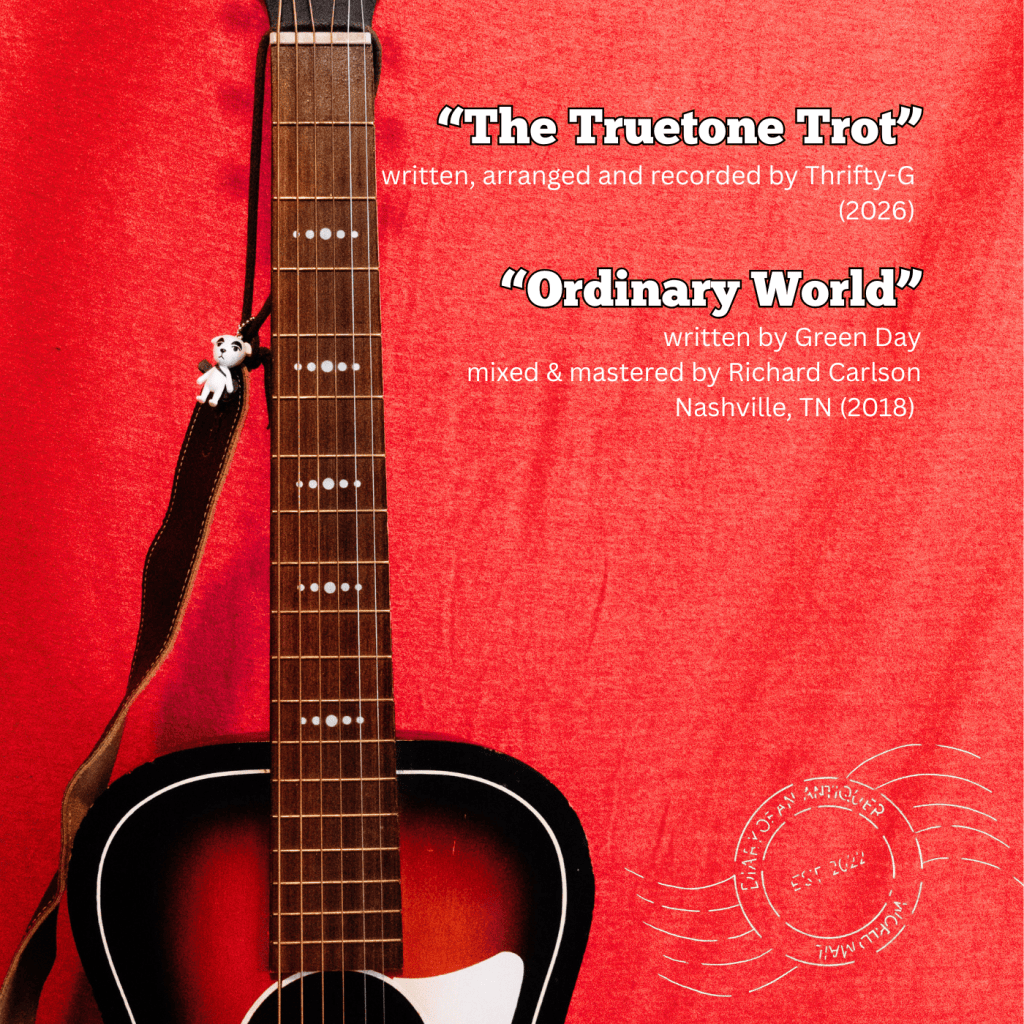
It’s fun hearing the guitar from another chapter in time, as well as in comparison to today. To know this instrument is over sixty years-old and is still making music brings me joy. If you’re interested, listen & downloaded the Truetone Tunes EP (for free) below.
“Truetone Tunes” by Thrifty-G (aka me) – exclusively on BandCamp
And don’t forget to check out the full video on the YouTube channel!
Special thanks to:
- Matt at Sohl Guitars in Harrison, Maine, for taking the time to look at (and spruce up) the guitar.
- Stephen from Vintage Parlor Guitars and Mike from Harmony guitars for answering my questions and sharing their expertise with me.
- Richard in Nashville, Tennessee, for originally recording the Truetone parlor acoustic guitar back in 2018, and for also letting me feature the recording in this post.
Works Cited
Acoustic Guitar Magazine. “Parlor Guitars: Brief History and Buyer’s Guide.” Acoustic Guitar, 12 Sept. 2025, acousticguitar.com/parlor-guitars-a-brief-history-and-a-2020-buyers-guide/.
Chipman, Stephen. “The Truetone Parlor Acoustic Guitar.” 25 Jan. 2026.
Harmony Guitars. “The Truetone Parlor Acoustic Guitar.” 26 Jan. 2026.
Danner, Peter . “The Guitar in Nineteenth-Century America.” The Soundboard Archive, vol. 3, 1985. The Soundboard Scholar, digitalcommons.du.edu/cgi/viewcontent.cgi?article=1009&context=sbs.
Race, Paul. “The Myth of “Parlor Guitars.”” Creekdontrise.com, 2024, creekdontrise.com/acoustic/parlor_guitar/parlor_guitar.htm.
Seeger, Mike. Early Southern Guitar Sounds. Smithsonian Folkways Recordings, 2007
Seeger, Mike. “A Brief History of the Guitar and Its Travel South.” Smithsonian Music, 16 June 2016, music.si.edu/story/early-southern-guitar-sounds-brief-history-guitar-and-its-travel-south.

